Support for those who support others.
Caregiving can overwhelm you fast. We're here for the calm in the chaos.
One day you're a son, a daughter, or a spouse. The next, you're also the medical chauffeur, the family's default doctor-lawyer-accountant, and the one who's supposed to remember every medication, account number, and the name of the elder-law attorney nobody's called yet.
The Boomer Guide is a free library built for exactly that moment. Real answers to what families ask most, from someone who's lived it. We'll mention a guide here and there when it can help you stay organized, but nothing on this site requires a purchase to be useful to you.

Free from The Boomer Guide
Start with the one thing every family should have ready.
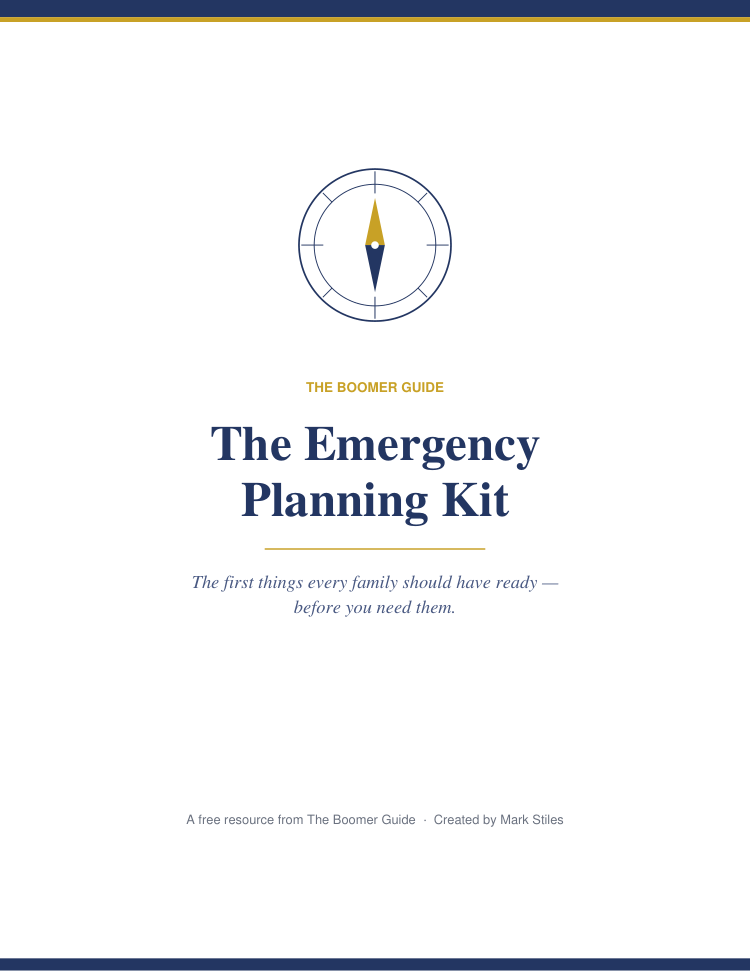
The Emergency Planning Kit is a free, fill-in checklist for the information you'll need the moment a hospital calls: medications, contacts, insurance, and the decisions no one wants to make cold. No purchase, no catch.
Send me the free Emergency Planning Kit
Hi, I'm Mark
I built The Boomer Guide when I learned how much there is to know
I'm Mark Stiles, and I started The Boomer Guide and the Caregiving Guides while helping my own elderly parents. I kept wishing someone had handed me a simple, organized place to keep track of everything and to understand what to ask. So I made these organizers and resources for me, my family, and now for you.
Mark Stiles, Founder, The Boomer Guide and Caregiving Guides
What families search for most
These questions keep you up all night. We answer them here.
Tap any one below. Each gives you helpful information on what to gather first, and what to ask the doctor, lawyer, or agency on the other end. (We don't provide medical, legal, or financial advice.)
How do I talk to an elderly parent about accepting help?
Start by understanding why they're resisting. Usually it's about holding on to independence. Lead with concern instead of criticism ("I noticed the fridge was empty. Is it getting hard to shop?"), and try to agree on a plan before a crisis forces one. It goes better when you arrive organized: what you've noticed, the questions you have, and who else should be involved.
What are the signs an elderly parent needs assisted living?
Look for a pattern, not a single moment: missed medications or appointments, recent falls, weight loss or spoiled food, unpaid bills, growing confusion, a neglected home, or pulling away from people. When several show up together, it's the cue to write down what you're seeing and talk with their doctor.
Does Medicare pay for assisted living or long-term care?
Generally, no. Medicare doesn't pay for long-term residential care like assisted living, memory care, or nursing-home stays. It covers some short-term skilled care after a qualifying hospital stay, and certain in-home skilled services. Long-term costs are usually paid privately, through long-term-care insurance, or through Medicaid for those who qualify. Confirm specifics at Medicare.gov or with a licensed advisor.
How do I get power of attorney for an elderly parent?
A power of attorney is a legal document letting someone act for another person; a medical (health-care) POA covers health decisions if your parent can't make them. The forms and rules vary by state, and an attorney usually prepares them, ideally while your parent can still take part.
I'm overwhelmed caring for an elderly parent. What should I do?
Burnout is a signal to get support, not a sign you're failing. Name the top three things that need attention, decide which is truly first, and look at who can share the load: siblings, your Area Agency on Aging, respite care, or a support group.
What are you experiencing?
Start where you actually are.
A health change, a hospital stay, or the paperwork nobody planned for.
If you want it all in one place
Everything here is free. If having a guide to help you stay organized, we offer those at an affordable price.
The Boomer Buddy Guide and Boomer Money Guide are our two most-used organizers, and there are nine more Caregiving Guides for the specific decisions families face: emergency planning, digital assets, elder care, power of attorney, and more. Every guide lives on our sister site, Caregiving Guides, with a full look inside before you buy.
People & resources
When you need more than a guide.
Sometimes a guide isn't enough. You need a person. We've gathered the verified helplines, agencies, and local-support options caregivers turn to most.
The Boomer Beat · Legislation Watch
A nonpartisan eye on the laws that affect caregivers and the families they support. Read The Boomer Beat →
Caregiving changed your work? Mark offers services to help new caregivers find other revenue →
Part of the Boomer Guide family: Caregiving Guides · Boomer Money Guide · Mark Stiles Marketing